One of the Black Notebooks’ little surprises is Heidegger’s praise for the painter Caspar David Friedrich, whom he calls “a peak towering into the godforsaken spaces of the divinity of the onetime God,” a figure on a par with Hölderlin (GA 95: 364/285 tm). Heidegger must have known what is today Friedrich’s most famous painting, The Wanderer Above the Sea of Fog. A man adopts a bold stance on a craggy peak, and we look out with him over a breathtaking landscape where the lower elevations are shrouded in mist. Heidegger must have felt that exhilaration when thinking of himself as one of the rare dwellers on mountaintops. But did he reflect on the mist? The wanderer in the painting has a magnificent view, but he does not see all: the clouds obscure the valleys below. Maybe he does not care—maybe that is part of his triumphant mood. So be it. But at least he should realize that he does not know what lies under the mist. The heights are heights of both knowledge and ignorance. In his Olympian pose, Heidegger not only fails to see through the mist, but fails to see the mist itself. He not only has no sympathy for real, suffering individuals, but also thinks that he knows them when he does not. The dismissive statements in the notebooks—such as the repeated claim that he is living in the age of the total lack of questioning and thought—are themselves thoughtless, because the fact is that he does not know whether others are questioning. Zarathustra must go down in the beginning of Nietzsche’s book, and the philosopher-rulers must return to the cave in the Republic. Heidegger, who blames Platonism for so much, failed to learn the lesson of Plato’s allegory. The philosophers return to the cave not only in order to save the polis, but also in order to understand the political realm in its particularity after spending time in the light of the intelligible forms. When they first return, they are unable to see in the relative darkness (Republic 516e, 518a). Knowledge of essences, then, does not suffice to grasp politics; we must both ascend and descend, and take the time to adjust our understanding to both realms. Heidegger’s interpretations of the allegory of the cave exemplify blindness instead of recognizing it: he wrongly asserts that “with his view of essence [the philosopher] can now see what happens in the cave for what it is” (GA 34: 89/65). He takes the returning philosopher simply as an enlightened liberator who may be the victim of the deluded masses’ stupidity and resentment, rather than understanding that the philosopher himself needs to relearn to see in the dimness (GA 34: 80–94; GA 36/37: 180–85).

Time and Trauma
Thinking Through
Heidegger in the Thirties
Richard Polt

ВЪЗКРЕСЕНСКА РЕПЕТИЦИЯ

Лазар събуден
Преждевременно
Сред сомнамбули

CUTTING TOGETHER – APART

Срещата пропусната
С квантовия ефект
На нелокалност

КАРАНТИНА

Проваляните
Удоволствия в наслаждението
От провала

КАРАНТИНА-2

В геноцида
На Аушвиц не можеш да умреш
За другите

INDISCERNIBLES

Изваждане
Като прибавяне към Булеанови
Пълчища

ФАЛОСЪТ Е АНГЕЛ

Ангелите
Нямат секс защото са cogito
На секса

THE VOID

Мениджмънт
На пустота в неопределения регистър
На бога мъртъв

ЖЕНАТА НЕ СЪЩЕСТВУВА

Освен
В маскарадно екраниране на мъжката
Фантазия

Trompe-l’œil

Под фалическия
Знак жената винаги
Е майка

НЕБОСВОД

В безкраен отказ
Циркулират звезди на неабсолютната
Визита

ВЕЛИКИЯТ МАСТУРБАТОР

Всичко
С нокти няма как
Да мастурбира

ПЛАНИНСКА МАТЕМАТИКА

Скалите
Криеха от нас лабилните си
Изчисления

НАДПИС В СОЗОПОЛ

За правата
На камъните се застъпват голите
Туристи

ДИФРАКЦИЯ

Пейзаж във виртуален
Отсек на неаксиоматизирани
Решения

ДЗЕН-КВАНТОВ СВЯТ

Енергийна
Орбита на жабешкия скок
Извън локация


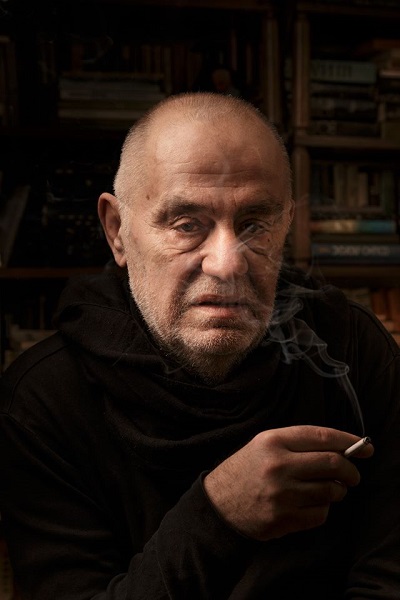
Zarathustra (Un)Vaccinated by Zlatomir Zlatanov

 2020-04-08

Zlatanov.jpg

Photo by (c) Mario Shumanov

LOCKDOWN THEORY #24

Between me and the other there is only the discourse and the death.

Signifiers as thwarted impulses (of the death drive) – why not say the same for pathogens, they are death in the form of human life (“Politics is therefore death that lives a human life,” à la Achille Mbembe).

We have always been the infected uninfected, the abandoned-symbiotians. In its origin democracy is an autoimmune disease, albeit within the realm of the nihilism of sign and the number.

Thwarted citing, love is citational, and death too. Panics and pandemics – citational ones, thwarted discourse and thwarted death.

Our ontological dignity is hurt. Is there a biological dignity – or is this too literal a vision?

With signifiers one seeks the signifieds, with viruses – the patient zero. But here there is only parting ways à la Borges, stopped as they are in the access fetish. The access as non-access.

At the very boundaries of thought and language there is an inherent structural form of contradiction, an in-closure. The closure of the boundaries of any system is thinkable only as its pаradoxical in-closure.

Are we talking about fusional bio-ontologies?

And what of the fixism of the limitation-of-size principles – and their dis-fixing in other fixisms?

Literalism vs. deliteralization of discourses.

Inhuman Sphynxism of the human, reductive literalism of (somatically ­rooted) drive vs. defense, “anatomy is destiny.”

This is the fixism in the missed encounter with the unlimited Real of the ontological, of the sexual relation, of the trauma, miniscule steps in formalizing the Real, a passion for the virusless exo-world.

The limit of experience as the limit of the limit, chiasms, oxymorons à la Orwell or endless Kantian judgements. Illness is health. Panic is the best order. The virus is the best disinfectant.

The indefinite animal is in an indefinite universe with no cosmological constant, a world of the not-all, or worse, an anti-world without anti-philosophers. And even worse than that, a non-world with non-decisional non-ontologies. Exo-non-ontologies of the Real, the exo-mathematical heaven of Hilbert avec Laruelle.

Animals are transformed into linguistic flexions, into temporal reflexions – is this our ontological vaccination? The intervalled animals of the intervalled pseudo-epochality. And the un-intervalled cosmic extinction as pole position, an aposteriori apriori in relation to which the Terminator-like design of spacing and difference fades away.

Enjoy the ontological gourmet, plateau, palimpsest, along with authors uncited as if cited, with the inhuman signifiers and the stellar innards of astral intestines (the ancient knew this, and so did Byron in Song X of the Don Juan), the horror of the belly’s innards, the different sensorium, the gastric juice that leaks as a Styx through the black liver.

A non-access to the present with its unpresentable, Hölderlin’s das Unmittelbare is inaccessible to both common people and gods, uttered by the autoimmune poet as the thwarted citation of Heraclitus so that it gets sutured to Pindar.

The chance to save ourselves is as unpresentable and unseemly as the virus of arbitrariness.

The sovereign decides not only regarding the exception, but also about what is normality. Man-made sovereignty. The fusion of endless Kantian judgements, for example, the emergent/the exceptional is the veracious normality. The bio-ontological of man-made lab viruses, self-replicating genes and cellular automata. And of the Natur-made viruses imitating the “anthropology of competitiveness.”

The indirect guilt of neoliberal biopolitics is no longer actual. In the pandemic we are the abandoned of the absent cause, in the absence of cognitive mapping as substitute of class war – both are unactual.

Catastrophisms are literalisms.

The symbiotic Gaia apparently still does not know what she can do as a Spinozist body in the antidote of the organless body of death.

If philosophers and pathogens are locked inside the correlate, then is not the ambiguous fixism of the Great Outdoors yet another viral concubinage?

We would rather ask ourselves: is there anything like the witness of the absolute visit, an intransitivity as the pathogen of correlationism?

Bio-medicalism produces antibodies which are fusional strategies of pretending to pretend, which pretend to pretend being viruses so that they defer and postpone the Real of the virus, once the viral extinction is impossible, the death of death.

We still throw up the Oracle at Delphi’s hallucinogen and this does not concern an anal trap, but the old spasm of Lovecraft.

Consciousness is geometrical, the guttural innards are part of astronomic numbers.

Digestion and knowledge are in different mathematical spheres.

What, for those hundred trillion cells in the human body, is their literal dignity?

Primitive and instinctual neurological substrate of the mind vs. uniquely human and symbolically structured nature of the unconscious. Primordial, biologically based death instinct vs. narcissistic wish to occupy the phallic position, the Symbolic or cultural order (Donald L. Carveth).

Will the biopolitical rise to the level of its own artefact?

Does not immunization via contained contagion resemble the appropriation of cultural symbolic forms through Oedipalization?

This logical Oedipality is impossible to clean.

The divinatory theology of the inaccessible enjoyment is in the portional intervalling of surplus enjoyment.

Again, the immediate is inaccessible for both gods and people. Probably today this is going to be related to the unseparated myth of the given. Or to the virginal chance beyond the dice and its prostituting numbers.

Yet in fact a paralogism has been uttered. The interdiction to refer to a self-articulating totality has been transgressed and the first to do that was Parmenides the father, while he was pretending to pretend that he delivers an ontology (Paul Livingston).

The system of the Church is like the system of ontology.

All religions are based upon the hallucinatory value of the “the unscathed” (l’indemne), the pure and the untouched, the sacred and the saintly, and respectively the same goes also for the ontologies in a thwarted access to self-articulating totalities.

Not even ontologies, it is even worse – the pre-ontological waiting room as khōra, after the non-predicative schema of neither-nor – what else is this if not the guarantee of immunity?

The same is true for the unconscious as it is emplaced in the pre-ontological as the unrealized of the neither-nor – a struggle for the pole position.

Why not emplace here, i.e., not-here, also the pathogenic, neither sensible nor intelligible, neither alive nor dead, neither being nor non-being, or even becoming, a “something that no dialectic, participatory schema, or analogy would allow one to rearticulate together with any philosopheme whatsoever…” (Derrida, “Khōra”).

Angels are as the deactivated viruses, an idiomatic writing as a radiant glory. A non-negative chance, a principle of the ruins in the thing itself, the non-assigned metaphysical topica of the pathogen as the embodiment of the undead object in a clinical demonology, etc.

God is the unmarked, just as the unpresentable present is unmarked, das Unmittelbare.

Meister Eckhart’s Gelâzenheit is another fetish for the unlimited volume, an absolute immunity and absolute quarantine, a relaxation under the influence of the attractor-God.

A Spinozist attractor under the morphismic vibration. An attractor-arche-trace under the differential vibration.

The nihilism of signs is handcuffed, the nihilism of temporal spacing is compromised, just as the shelf of Borges’ infinite library is anthropomorphically fixed, spaced.

Even Lacan is accused of literalizing the hole that produces the lack, this literal hole is always already semiotized – and is not this valid also for the Void, for the anxiety in front of the Void of the unpresented singularities of the unpresentable biopolitical Empire?

Аn errant and measureless obscurity in which imperial biopower is enveloped, this drifting obscurity of the imperial Dasein – as it turns out, this symbolically threatening presentment is clinically approved.

“Nothing in common, nothing immune, safe and sound, heilig and holy, nothing unscathed in the most autonomous living present without a risk of autoimmunity” (Derrida, Acts of Religion).

“Only to God does inactivity (anapausis) really belong”, writes Philon avec Agamben, “the Sabbath, which means inactivity, belongs to God” and, at the same time, is the object of eschatological expectations (“they shall not enter into my inactivity” [eis ten anapausin emou]).

Still, how miserable this is, anapausis of the divine respite, and for us – the quarantine of pseudo-Sabbath.

Mathematics evades the limiting paradoxes by inventing new mathematics, and the same is true for ontologies – is not this a viral behavior? No one can substitute me in vomiting my own guts. Nor in the ontological neurosis as super-reaction (Nick Land).


Translated from the Bulgarian by Stanimir Panayotov


Zlatomir Zlatanov (1953) is a poet, writer, and critic, one of the mavericks of Bulgarian postmodernism, author of Palinodies (1989), largely considered the first openly postmodernist poetry book in Bulgaria. His novelette Exitus (1982) was adapted for the 1989 movie with the same title directed by Krassimir Kroumov (to this day considered one of the most representative Bulgarian films concerning the perestroika). Zlatanov is most (in)famously known for his poetry book On the Island of the Coprophiles (1997). In the late 1990s and early 2000s he began developing an increasingly theoretical lexis (beginning with Protocols for the Other, 2000) and later engaged with the thought of Lacan and Badiou, publishing novels such as Lacanian Networks (2005) and the series of essays, Alain Badiou, Or, the Persistence of Illogical Worlds (2008).

Вижте повече на IDENTITIESJOURNAL.EDU.MK

(с безкрайна благодарност към Станимир Панайотов – от автора)

… allow me to recall a memory
I have from ‘Old Berlin’, during or maybe even before the Wall. In
the eastern sector, in the subway stations, one was often confronted
with huge posters proclaiming ‘Von Ich zum Wir’: ‘From I to We’, the
response of East Germany to the burgeoning individualism of the West.
But this call to the collective was surely one of the reasons why Theodor
Adorno, at about the same time, was demonstrably allergic to the use of
‘we’ in his writing and speaking.

Lacan finds the roots of psychosis in a
fundamental failure of oedipalization to establish in the unconscious the
signifier of the phallus, the Name-of-the-Father, as the primal cut or castration dividing infant and mother and opening up a space for symbolization. But this theory is rendered equivocal by his positing of a literal hole
in the unconscious, thereby failing to recognize this “hole” as itself a
signifier, the signifier of absence or lack. As we have seen, Lacan succumbs to a metaphysical view of absence as somehow constituting an
ultimate reality beneath or beyond signification. As we will see in the
next chapter, this is the same problem that bedevils the work of Ernest
Becker and Peter Berger who reify death anxiety and anomy as realities
beyond signification. It is this metaphysical bias, which prevents Lacan
from seeing that the “hole” in the unconscious results not from a failure
of the primordial cut, but from its successful, but overwhelmingly traumatic, registration. Similarly, when Muller asks what is cut short here, I
am inclined to respond that to cut short is nevertheless to cut. The child can only reject castration if its signification has already been encountered. The hole, gap or lack is already the registration of castration. In
this respect, Lacan himself falls prey to the literalism that bedevils other
psychoanalytic theories that posit a literal “defect” in the ego as the basis
of the more severe forms of psychopathology.

Donald L. Carveth

Lacanian theory: appreciation and critique


АЛГОРИТЪМ

Ave Maria
G. Caccini /Вавилов
КГБ

АСЕМБЛАЖ

Птиците
Към моста
Спадат

THE ONE GOD UNIVERSE

Агенти
На Едното в кастрацията
На излишък

ДЗЕН-ГУРМЕ

На гладно
Пия водка белейки
Картофи


PARAMARTHASTAVA

От дхармите
На алкохола
Нирванизиран


COPYRIGHT

Любов

Цитатна в катахрезата

На авторското право


ФЮЧЪРС-СДЕЛКА

Богове
Ипотекирани в емблемата
На незавръщане


АБАНДОНИЦИ

Сред безразличната
Природа на екология залагат
Без природа


КНИЖЕН  АПОКАЛИПСИС

Гнидите
На Откровение библействат
Върху рафта


ПАНДЕМИЯ

Шанс
Невзрачен като вируса
На произвола


ПО ПОВОД МАЩАБИРАНЕТО НА ВИРУСА И ЩАБОВЕТЕ

Ето какви телеграми се разменят между германския и австрийския ген-щабове по време на ПСВ:
Германците пишат – положението е сериозно, но не и катастрофално.
На което австрийците отвръщат – положението е катастрофално, но не и сериозно.
(Вицът е на Жижек)


Why Europe is the biggest loser
Veröffentlicht am 17.01.2020 | Lesedauer: 4 Minuten
Von Slavoj Žižek

However, we should nonetheless resist the temptation to treat the ongoing epidemics as something that has a deeper meaning: the cruel but just punishment of humanity for the ruthless exploitation of other forms of life on earth or whatever…
But if we search for such a hidden message, we remain premodern: we treat our universe as a partner in communication. Even if our very survival is threatened, there is something reassuring in the fact that we are punished – the universe (or even Somebody-out-there) is looking at us… The really difficult thing to accept is the fact that the ongoing epidemics is a result of natural contingency at its purest, that it just happened and hides no deeper meaning. In the larger order of things, we are a species which doesn’t matter.


Why Europe is the biggest loser Veröffentlicht am 17.01.2020 | Lesedauer: 4 Minuten Von Slavoj Žižek

However, we should nonetheless resist the temptation to treat the ongoing epidemics as something that has a deeper meaning: the cruel but just punishment of humanity for the ruthless exploitation of other forms of life on earth or whatever…
But if we search for such a hidden message, we remain premodern: we treat our universe as a partner in communication. Even if our very survival is threatened, there is something reassuring in the fact that we are punished – the universe (or even Somebody-out-there) is looking at us… The really difficult thing to accept is the fact that the ongoing epidemics is a result of natural contingency at its purest, that it just happened and hides no deeper meaning. In the larger order of things, we are a species which doesn’t matter.


ВИРУСЪТ КАТО ФОРМА НА ЖИВОТ

В готическата естетика чудовището предположително означава предупреждение и спектакъл.
Предупреждението, че всички ние сме, може да бъдем или ще бъдем чудовища с девиантни, болни, деформирани тела.
Така увредените тела в готическото въображение са карнавални тела не само в своята гротескност, но по-важно, в своята функция като подривни гнезда, тоест напомняне, че същото може да се случи със здравите тела по всяко време и без предупреждение.
Другостта на готическото тяло на чудовището е с флуидния потенциал да разруши нормалните бинарни деления, примерно, на младите, красивите и умните срещу старите, грозните и юродивите.
Идеята е, че всички имаме своите демони вътре в нас, проблеми, на които да погледнем лице в лице.
Прикаченото чудовище на вируса сякаш се изплъзва на това определение, само за да го потвърди.
Другият в термините на телесна ненормалност е изравнен с нормалното тяло, което се оказва идеологическо-медицински конструкт, лесен за компрометиране – зрелището се прехвърля към нормалното, всички тези циркове, с които се защитават от вируса.
Но кой е Другият? Лакан ползва големия Друг като име за социален авторитет, една анонимна сила, която поставя имплицитните и по необходимост неконзистентни правила за социално взаимодействие. Когато заявява, че големият Друг не съществува, Лакан просто настоява на неговата неконзистентност и неспособност да оторизира дефинитивно всяко изявление.
Именно демократичната истерия е насочена да се излива в тази неконзистентност и аморфност на Другия, в празното място на властта, в пустите дхарми, и да извлича принадено наслаждение от това (surplus jouissance) (Lacan’s plus-de-jouir).
Вирусът е въплъщение и симптом на това травматично наслаждение в момента, когато предупреждение и спектакъл са се омешали непоправимо.
Наслаждението като пренаписване на влечението към смъртта с вируса на езика – ние го искахме, но вирусът го направи, кой вирус все пак?
Истеризираните изкуствено чудовища на демократичния режим – едновременно да се обличат и да си късат дрехите – буквално се припокриват с евентуалните жертви на вируса с техните карнавални маски.
А какво за предупредителния спектакъл на мигрантите – не спектакъл, а съкрушителен удар срещу нормалните понятия за раса, нация, джендър, сексуалност, класа.
Но може би Другият е бог. Кой бог все пак?
Също като прикачения вирус, бог е тази неконзистентна монстрозност, с която сме неспособни да скъсаме връзка – бог e предлог, с/със.
Как се наказват тези, които искат да скъсат връзките и да отхвърлят въжетата?
Втори псалм:
Тоя, който седи на небесата, ще се смее/Господ ще им се поругае
Горко на този, който не се е научил в стила на Майстер Екхарт да се смее в лицето на бог, да се уповава на взаимния смях, а с дезертьорски индивидуализъм търси спасението в грешна посока.
Но ако не старозаветен бог с неговата смехова терапия, тогава Лейди Гага:

When they’re young all little monsters learn that they are scary,
ugly, stupid, shunned by cupid, overweight and hairy,
but every monster needs to find that secret deep inside
that transforms doctor Jekyll into sexy Mr. Hyde! (…)
Monsters don’t need implants or a bitchin’ monster car,
monsters only need to love the monster’s that they are.


мигранти

Българите с тяхната противна топология на гнездене сега отблъскват мигрантите. Щели да ни залеят, да ни смачкат. При това се казва от хора, които се окайват, че не сме никаква нация, че сме корумпирана държава.
Истеричният дискурс, който държим, е отправен към един Друг който не съществува (а тук в буквалния смисъл, тъй като дори мигрантите ни заобикалят като чумави), и само от мястото на Другия бихме получили някакъв отговор на собствената си истерия кои сме ние.
Но аз няма да говоря за патриотичната психоанализа, която се упражнява в момента, с илюзията на незасегнат или предположително знаещ.
Съблазнително е да се подведеш от глобалистки абстракции за гостоприемство, космополитизъм, анти-едиповщина и т. н., но още по-лесно е да се затвориш във вонящите парохиални локализми на свое и чуждо. Изборът да избираш ни злепоставя постоянно, защото е положен върху бекграунда на по-скоро онтологическа неопределеност, отколкото човешка несигурност – няма вселени, те са раздалечаващи и саморазрушаващи се, в един Космос, който ще свърши.
С изобретяването на парния двигател фактически откриваме втория закон на термодинамиката, ентропията, топлинната смърт.
А мигрирането какво ни говори? От стабилен парменидов свят в радикално непостоянния хераклитически свят – между тях шорткът на прелетни неконзистентни множества в изчезващата точка на ефимерни събития.
Историческата трайност е толкова дебилна, колкото и онтологическата неопределеност като друго име на бъдеще.
Но ние сме в модалността на „шяло е да бъде така”. Тоест каквото проблематично решение вземем с по-късна дата, тоест винаги закъснели във future anterior.
Но решението е винаги същата схизма, от която произхожда етимологически – дисизиционистка схизма на суверена някой да оцелее по-дълго за сметка на останалите в един загиващ космос, на ръба на една изстиваща звезда.
Воля за надмощие посред радикалното изличаване и изчезване (extinction).
Проектът за вечния мир е смокиновия лист на Просвещението. Вечният мир означава днешния свят да е напълно деинституционализиран, тоест да се самоотмени, което ще е по-страшно за него от космическо измиране.
И този свят прави някакви жалки опити в това отношение, например, смъртта на бог мимикрира ентропийната дисипация.
Или капиталистическото турбо-несъзнавано акселерирано до дупка, тоест преусвоявайки влечението към смъртта.
Дори квантовият вакуум е населен с призраци, които вече минават през брандиране.
Космополисът е танатополис.
И сега тези бежанци, които някои вземат за симптом на виталистки импулс. Но веднага в тях се инсталира парохиалното – има наши мигранти и бежанци, окайвани още от Яворов, както сигурно щеше да го направи и с палестинците.
Но от тъмните ядра на Изтока и на Африка извират още неустановени прелетни множества – те наши ли са или чужди?
Не трябва ли преди всичко да се напомни, че те първи са минали през колониално брандиране на щели са да са това, което са, защото такова е било решението на колонизаторите и политиците, на които и българите са яли попарата относно „восточния” въпрос.
И сега милосърдието и гостоприемството са досадни абстрактни императиви, така ли? Когато варварите са пред портата?
Европа, тази поредна римска империя, при това от същите две части, щяла да загине от тези, които се е опитала да унижи и изличи?
От гръцки Европа означава ясна визия, противно на този изплашен поглед.
Европа първо трябва да се деинституционализира извън сегашната си противна бюрократичност, трябва да изчисти визията си от неизличимия имперско-капиталистически остатък, ако иска да обгърне просветлена и просветена света, Европа да бъде светът.
Щяла е да бъде такава Европа, но кой да вземе решение там, където Ноевият ковчег и Троянския кон са неотличими един от друг?


Design a site like this with WordPress.com
Get started